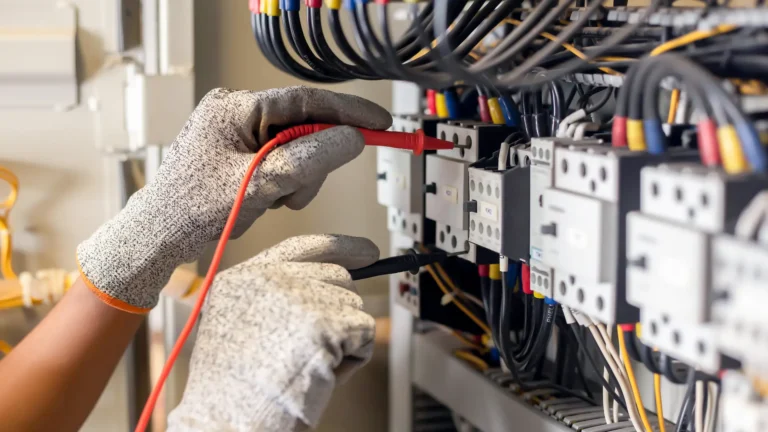
Four Most Common Electrical Safety Mistakes
1. Not using a junction box
Behind every light fixture and light switch there is a junction box. The j box protects the electrical connections, protects you from electrical shock and protects your home from electrical fires.2. Burying a junction box or open splice behind sheet rock
Concealing a junction box full of live or exposed wires is against all electrical building codes. Short circuits or wiring issues could easily cause a spark and catch the interior of the home's wall on fire before anyone could ever notice.
3. Not leaving the proper length of wires for splicing or attaching to a device.
Wires that are cut too short make wire connections difficult which is dangerous and increases the chances of a poor electrical connection.
4. Not providing ground fault protection when required
Ground fault circuit breakers will shut off electric power when it senses an imbalance between the outgoing and incoming current. We all know that water and electricity don't mix, so all kitchens, bathrooms, garages and the exterior of houses need ground faults for protection against an electrical shock.
Because of the potential financial gain, however, many local heating oil delivery companies have begun blending a percentage of biofuel that far exceeds this recommendation.For instance, there are several local heating oil distributors that are blending over 50% or higher. There is even one local heating oil distributor that owns a biofuel manufacturing plant that is blending 80% - and all in an attempt to increase their monetary gain. As usual, money and greed are a driving factor. Why should this matter to you? Because too much biofuel – even with all of its many benefits – can have a negative impact on your heating system. Specifically, because biofuel is not the same as #2 heating oil, it does not have the same viscosity of output BTUs. A blend of biofuel over 20% can actually cause oil heating equipment to burn dirty and foul the burning process. Keep in mind that damages caused by this are not typically covered by the manufacturer or the service company that maintains your heating equipment. To prevent costly surprises and protect your investment, should contact your heating oil distributer and ask specifically what percentage their blend is. (This must also be noted on the oil delivery slip provided by your delivery company.) Don’t take chances when it comes to your home’s heating system. Contact us today and get more than just a warm home. Get clean air and peace of mind.
Filtration
Filtration is the most common air quality product. This process prevents the indoor HVAC system from accumulating dust and other indoor particulates. Should you choose to go this route, a high efficiency media air cleaner is the best filtration for your money. We recommend choosing one with at least a MERV-8 filter. Electronic air cleaners cost a lot more money to install, operate and maintain.Humidification
The second most common air quality product for your home is humidification. This is most noticeable to those who either don’t have enough during the winter or have too much during the summer. Too much humidity can also be an issue in finished basements. If you want to add humidification during the winter season, there are a lot of products and options available to you. Similar to filtration, the best approach with humidification is to keep it simple and take care of it. Aprilaire humidifiers made by Research Projects are the best humidifiers on the market, dollar for dollar. They have three models designed for forced hot air systems. The Aprilaire 600 by-pass humidifier is the most common. It is a trickle-through humidifier that requires no reservoir of standing water. The model 700 is a power trickle-through humidifier that also works well. Both the 600 and 700 models add moisture to the air whenever your forced hot air heating system is operating. Keep in mind, however, that these types of humidifiers can only do so much based on heating cycle times and, in reality, may also offset how dry your home air will drop to. If you want true humidification, the Aprilaire model 800 steam humidifier is your best bet. The model 800 boils water in a steam canister and then distributes it into the duct system. At the same time, it will communicate to your forced hot air unit and turn the fan on to distribute it without turning on the heat. This thereby enables you to genuinely humidify your home.Dehumidification
Another option for improving indoor air quality is to dehumidify your home during the summer. You can do this automatically if you have central or ductless air conditioning. If you have forced hot water baseboard or radiant heat, however, you may need to add Mitsubishi ductless units. This will help to cool your home and dehumidify it at the same time. Mitsubishi ductless units provide very low-cost heating and cooling and feature a dehumidification mode designed to remove unwanted moisture without lowering or raising the temperature.UV Lights
Purified air has become a more important indoor air quality concern than ever, particularly with the COVID-19 outbreak. UV light is the best way to neutralize bacteria, mold, fungi and, yes, viruses. There are several models of UV lights made by Field Controls that can easily be incorporated into your home. The two most popular options include a duct mounted UV light in an existing forced hot air system or a self-contained unit that’s designed for homes without ductwork. The Fields Trio portable UV air purifier is sized to cover 1,000 square feet.Fresh Air
Last but not least, you can improve the quality of air inside your home by introducing outside air. New building codes have tightened up homes for energy savings and, as such, it has become more apparent than ever that changing the air in tight homes is not only a good idea, but a necessity. The only efficient way to do this is with an Energy Recovery Ventilator (ERV) made by RenewAire. This product not only removes old, stale, contaminated air and introduces fresh air from outside, but it also retains a good portion of the energy in the air and puts it back into your home through the RenewAires extraordinary static plate exchange core. This provides much cleaner and more efficient fresh air. At Wilson Brothers Heating & Air Conditioning Inc., we specialize in the professional installation and maintenance of in-home air-quality products, including all of the products listed above. For more information or to receive a free, no-obligation quote, please contact us today!2020 Rebates
| FUEL | SYSTEM | REQUIREMENT | REBATE AMOUNT | ||||
| OIL | Furnace with ECM Blower | AFUE ≥ 86% | $650 | ||||
| Hot Water Boiler | AFUE ≥ 86% | $800 | |||||
| Indirect Water Heater | Connected to Hot Water Boiler | $400 | |||||
| PROPANE | Furnace with ECM Blower | AFUE ≥ 95% | $1,000 | ||||
| Hot Water Boiler | AFUE ≥ 90% | AFUE ≥ 95% | $1,500 | $2,300 | |||
| Condensing Boiler with On-Demand Water Heater | AFUE ≥ 95% | $2,000 | |||||
| ENERGY STAR Qualified On-Demand Tankless Water Heater | UEF ≥ 0.87 w/electronic Ignition | $800 | |||||
| Indirect Water Heater | Connected to Hot Water Boiler | $400 | |||||
| NATURAL GAS | Furnace with ECM Blower | AFUE ≥ 95% | AFUE ≥ 97% | $1,000 | $1,250 | ||
| Hot Water Boiler | AFUE ≥ 90% | AFUE ≥ 95% | $2,000 | $2,750 | |||
| Condensing Boiler with On-Demand Water Heater | AFUE ≥ 95% | $2,400 | |||||
| Furnace with ECM with On-Demand Water Heater | AFUE ≥ 97% | $950 | |||||
| ENERGY STAR Qualified On-Demand Tankless Water Heater | UEF ≥ 0.87 w/electronic Ignition | $700 | |||||
| Indirect Water Heater | Connected to Hot Water Boiler | $400 | |||||
| ENERGY STAR Qualified Condensing Gas Water Heater | UEF ≥ 0.80 | $500 | |||||
| ENERGY STAR Qualified Storage Water Heater | UEF ≥ 0.64 Medium Draw UEF ≥ 0.68 High Draw | $100 | |||||
| ANY | Central A/C, Ducted | SEER ≥ 16, EER ≥ 13 | $50/Ton | ||||
| Central Heat Pump Mini-Split Heat Pump | Refer to Heat Pump Qualified Products List at MassSave.com/HPQPL | $250/Ton | |||||
| OIL OR PROPANE | Central Heat Pump Mini-Split Heat Pump | · Refer to Heat Pump Qualified Products List at MassSave.com/HPQPL · Integrated Controls required unless central heating system is removed. Refer to Integrated Controls Qualified Projects List at MsassSave.com/ICQPL | $1,250/Ton | ||||
| OIL OR PROPANE | Integrated Controls | · Add-on to existing central or mini-split heat pump system · Integrated Controls required unless central heating system is removed. Refer to Integrated Controls Qualified Projects List at MsassSave.com/ICQPL | Up to $500 per indoor unit, max of $1,500 | ||||
| Electric Resistance Heat | Central Heat Pump Mini-Split Heat Pump | 900 kWh difference between sum of 3 winter-usage and 3 lowest-usage months | $1,250/Ton | ||||
| ANY | Heat Pump Water Heater | ≥ 55 gallons, UEF ≥ 2.7 | ≤ 55 gallons, UEF ≥ 2.0 | $150 | $600 | ||
| ANY | Programmable Thermostat | New Only. Limit 4 per account | $25/Thermostat | ||||
| ANY | ENERGY STAR Certified Smart Thermostat | New Only. Limit 4 per account. Wireless connections must be enabled. See MassSave.com/Thermostats for qualified models | $100/Thermostat | ||||
Financing Options
Expand your purchasing power with Promotional Financing through Synchrony.
Synchrony is one of the nation’s premier consumer financial services companies. Our roots in consumer finance trace back to 1932, and today we are the largest provider of private label credit cards in the United States based on purchase volume and receivables.
- A simple application process, and fast credit decisions
- Unsecured, revolving credit lines
- Promotional financing options1
- Convenient monthly payment options
- Online account management
1Subject to credit approval. Minimum monthly payments required. See store for details.
For all promotions: Qualifying purchase must be made with your Home Design credit card issued by Synchrony Bank and a $29 account activation fee will apply and be charged at the time first purchase posts to account. For new accounts: Purchase APR is 26.99%; Minimum Monthly Interest Charge is $2. Existing cardholders should see their credit card agreement for their applicable terms. Subject to credit approval.

 The weather is getting colder and you maybe considering a new furnace or hot water heater. Mass Save is offering a variety of rebates that can be helpful in reducing the costs of purchasing new heating and hot water equipment in your home.
If your heating equipment is more than 20 years old, upgrading to an efficient heating system can save you energy and earn you rebates. Even a simple step like upgrading your home's thermostats can make a difference.
A simple programmable thermostat or wi-fi thermostat installation can save you quite a bit of money in heating costs and you may qualify for a rebate.
Many new heating systems qualify for rebates potentially saving you thousands! Not only will you have a more efficient heating system that can help you save money on your monthly bill but also get money back for installing one.
If you need a new hot water heating system you may also qualify for a rebate. See our list of 2020 rebates below.
The weather is getting colder and you maybe considering a new furnace or hot water heater. Mass Save is offering a variety of rebates that can be helpful in reducing the costs of purchasing new heating and hot water equipment in your home.
If your heating equipment is more than 20 years old, upgrading to an efficient heating system can save you energy and earn you rebates. Even a simple step like upgrading your home's thermostats can make a difference.
A simple programmable thermostat or wi-fi thermostat installation can save you quite a bit of money in heating costs and you may qualify for a rebate.
Many new heating systems qualify for rebates potentially saving you thousands! Not only will you have a more efficient heating system that can help you save money on your monthly bill but also get money back for installing one.
If you need a new hot water heating system you may also qualify for a rebate. See our list of 2020 rebates below.
| FUEL | SYSTEM | REQUIREMENT | REBATE AMOUNT | ||||
| OIL | Furnace with ECM Blower | AFUE ≥ 86% | $650 | ||||
| Hot Water Boiler | AFUE ≥ 86% | $800 | |||||
| Indirect Water Heater | Connected to Hot Water Boiler | $400 | |||||
| PROPANE | Furnace with ECM Blower | AFUE ≥ 95% | $1,000 | ||||
| Hot Water Boiler | AFUE ≥ 90% | AFUE ≥ 95% | $1,500 | $2,300 | |||
| Condensing Boiler with On-Demand Water Heater | AFUE ≥ 95% | $2,000 | |||||
| ENERGY STAR Qualified On-Demand Tankless Water Heater | UEF ≥ 0.87 w/electronic Ignition | $800 | |||||
| Indirect Water Heater | Connected to Hot Water Boiler | $400 | |||||
| NATURAL GAS | Furnace with ECM Blower | AFUE ≥ 95% | AFUE ≥ 97% | $1,000 | $1,250 | ||
| Hot Water Boiler | AFUE ≥ 90% | AFUE ≥ 95% | $2,000 | $2,750 | |||
| Condensing Boiler with On-Demand Water Heater | AFUE ≥ 95% | $2,400 | |||||
| Furnace with ECM with On-Demand Water Heater | AFUE ≥ 97% | $950 | |||||
| ENERGY STAR Qualified On-Demand Tankless Water Heater | UEF ≥ 0.87 w/electronic Ignition | $700 | |||||
| Indirect Water Heater | Connected to Hot Water Boiler | $400 | |||||
| ENERGY STAR Qualified Condensing Gas Water Heater | UEF ≥ 0.80 | $500 | |||||
| ENERGY STAR Qualified Storage Water Heater | UEF ≥ 0.64 Medium Draw UEF ≥ 0.68 High Draw | $100 | |||||
| ANY | Central A/C, Ducted | SEER ≥ 16, EER ≥ 13 | $50/Ton | ||||
| Central Heat Pump Mini-Split Heat Pump | Refer to Heat Pump Qualified Products List at MassSave.com/HPQPL | $250/Ton | |||||
| OIL OR PROPANE | Central Heat Pump Mini-Split Heat Pump | · Refer to Heat Pump Qualified Products List at MassSave.com/HPQPL · Integrated Controls required unless central heating system is removed. Refer to Integrated Controls Qualified Projects List at MsassSave.com/ICQPL | $1,250/Ton | ||||
| OIL OR PROPANE | Integrated Controls | · Add-on to existing central or mini-split heat pump system · Integrated Controls required unless central heating system is removed. Refer to Integrated Controls Qualified Projects List at MsassSave.com/ICQPL | Up to $500 per indoor unit, max of $1,500 | ||||
| Electric Resistance Heat | Central Heat Pump Mini-Split Heat Pump | 900 kWh difference between sum of 3 winter-usage and 3 lowest-usage months | $1,250/Ton | ||||
| ANY | Heat Pump Water Heater | ≥ 55 gallons, UEF ≥ 2.7 | ≤ 55 gallons, UEF ≥ 2.0 | $150 | $600 | ||
| ANY | Programmable Thermostat | New Only. Limit 4 per account | $25/Thermostat | ||||
| ANY | ENERGY STAR Certified Smart Thermostat | New Only. Limit 4 per account. Wireless connections must be enabled. See MassSave.com/Thermostats for qualified models | $100/Thermostat | ||||
What is a Standby Generator?
Standby generators are backup generators that automatically power your home in the event of an outage. Unlike portable generators, standby generators produce enough electricity to power your entire home, which is why they are also sometimes referred to as “whole house generators,” though they can be customized to power only specific appliances if desired. Standby generators are typically installed outside the home, similar to that of an outdoor HVAC unit, and require professional installation. Because these generators are connected to your home’s propane or natural gas lines, they are capable of powering the property for as long as needed. When the generator detects an outage, it can begin providing backup power in as little as 20 to 30 seconds.Why Invest in a Standby Generator?
Improve Safety – Living without electricity can get dicey – especially once the sun goes down. Not only is it unsafe for your family to have to find their way around in the dark, but as mentioned, if there’s no heat and the temperatures dip, it could pose a health risk, particularly to young children and the elderly. Save Money – When the power goes out, that means the fridge no longer operates. Losing electricity for an extended period of time could easily result in spoiled food, which is like throwing money out the window. Likewise, if the power is going to be out for a while, staying in a hotel may be the best option, but that’s an expense you wouldn’t have otherwise incurred. Prevent Damage – Freezing cold temps and no power can quickly lead to frozen pipes, which could burst and cause flooding within your home. Likewise, if the power goes out during a bad storm and there is flooding in your basement, if your sump pump isn’t operating, the damage could end up being quite extensive. Insurance Credit – Many home owners’ insurance providers offer credits for loss mitigation. Because having a standby generator can help prevent things like frozen pipes and basement damage, it is an appliance that is typically viewed favorably by insurance companies. As such, this credit could lower your monthly premium, keeping more cash in your pocket.Trust the Professionals
If you’re interested in having a standby generator installed at your home, it’s important that you choose your contractor wisely – especially since the equipment will be linked in with your gas or propane line. The technicians at Wilson Brothers are experts in standby generator installation. Furthermore, as part of our commitment to delivering the best service possible to our customers, we are proud to partner with Generac, the #1 selling brand of home backup generators. Contact us today for a free, no obligation quote.Boilers – Then vs. Now
Old style boilers were huge and held a lot of water. As a result, the water quality did not matter as much to these old-school systems as it does now. That’s because high-efficiency boilers feature much smaller, tighter water passages which can plug up and limit or stop water flow altogether. This reduces system efficiency and can cause major service problems, up to and including catastrophic system failure if not properly treated. Simply put, if you have a high-efficiency boiler, you should be investing in ongoing water treatments.Why Water Treatments Matter
The water that flows through the pipes and into your boiler contains everything from gasses and minerals to particulates and organics. When pH goes unbalanced and oxygen is allowed to dissolve, it can result in excessive corrosion. Additionally, over time, buildup of sludge, mud and other contaminates can gather at the bottom of the boiler. This can negatively impact the system’s ability to adequately transfer heat. Water hardness also plays a significant role in the performance and longevity of hydronic systems. Hard water is determined by the level of magnesium and calcium that is present which, when heated, can form scales that build up in the heating system. This can ultimately affect efficiency, which can lead to higher energy costs. In some instances, the scale buildup caused by hard water can result in cracking, leaking and eventually, total system breakdown. Lastly, poor water quality can sometimes void system warranties, which is always bad news. In cases like this, when a heating system fails prematurely and it’s due to scale buildup or something else relating to water quality, the equipment manufacturer may refuse to honor the warranty, leaving you holding the bag for an entirely new system. In fact, many boiler manufacturers actually require that minimum water quality standards be maintained in order to keep the equipment within the warranty.How to Tell if Your System is Good
The best way to prevent a problem with your system is to consult with a heating professional. This will allow the technician to measure the quality of the water in your hydronic system to ensure that the appropriate amount of chemicals are being used. This is important, since certain pieces of equipment like pumps and heat exchangers, can sometimes be sensitive to water quality. Proactively measuring current water quality and treating as needed can help you stay a step ahead of potential damage and efficiency issues. At Wilson Brothers, we want to help you get the most out of your boiler and heating system. Get in touch with our team of experts to schedule a checkup today!- Bob Gordon of The Portland Group
- S.G. Torrice
- Chris & Terry Woods of Advantage Insurance
- Scott Quinty of Sid Harvey
- George Antonakos of Total Air Supply
- Brian Baines of The Granite Group
- Holman’s Supply
- Gerry Miele of M&M Supply
- F.W. Webb
- Tom Cleary of Townsend Ford
- Paul & Karen Markham of Dunn Battery
- Ken Morgan of KRM Carpentry
- L.F. Robbins Insurance
- Frank Massarrelli of Frankco
- Jim Gmeiner of Gmeiner Law Firm
- Derek Ten Broeck of Ten Broeck Insurance
- Jay Edwards of Granite Financial Partners
- Rick Guay of Rick Guay Construction
- Brown & Brown Insurance
- Holmes Auto
- Merrimack Valley Truck
- Justin DiMucci
- Main Street Bank
- Tom Moore of Northern comfort
- Tom Carmichael and Sons
- Aspen Air Duct Cleaning
- Hillside Construction
- Wrightway HVAC
- Russ Demarest
There Are Several Ductless Pros
- Ductless systems have higher SEER and EER ratings than ducted units which means lower energy cost and better rebates.
- Zoning by rooms with ductless mini-splits is made easy and cost effective because you can do up to five indoor units to one outdoor unit giving you a five-zone system. That is not cost effective with a ducted system.
- The biggest pro that most consumers do not fully comprehend is the blower unit is in the finished space not in the attic. 100% of the cooling and heating is being directly distributed in the finished space, not being forced down a series of metal ducts to the rooms.
- The attic is the harshest environment in the entire home with temperatures in the winter the same as outside and temperatures in the summer 30 – 50 degrees higher than the temperatures outside due to solar gain from the roof. You are trying to force cold air through metal ducts in a space that is 120 plus degrees.
- Another issue is heat loss in the winter. The insulation in your attic is rated at R-40 with no penetrations through your ceilings. When you install a ducted system you have to cut holes in your ceiling to install the air supplies and returns into your attic then connect metal and flex ducts that are insulated to R-8 not R-40 by code.
- Because of this fact you cannot stop the heat loss and in some cases cause ice dams in the attics that have poor roof ventilation.
What is Indoor Air Pollution?
Gases and other particles that are routinely released into the air come from a variety of sources, including air fresheners. Regularly breathing in these pollutants can result in minor issues, such as asthma and congestion, to serious health problems, including respiratory disease and even cancer. In fact, the US Environmental Protection Agency lists indoor air pollution as one of the top 5 environmental health risks. Dangerous pollutants of indoor air include:- Combustion sources (i.e. oil, gas, kerosene, coal and wood)
- Carbon monoxide
- Tobacco products
- Radon
- Pet dander
- Mold
- Mildew
- Pesticides
- Lead
- Asbestos
- Household cleaning and/or personal products
What are the risks of poor indoor air quality?
The effects of breathing in unclean air can range from minor to serious. For instance, the presence of mold or mildew may exacerbate the symptoms of asthma and allergies. Others, like tobacco smoke, radon and pesticides can cause everything from respiratory and developmental problems to cancer and heart disease. Understanding these serious risks makes it much clearer how important it is to keep the quality of our indoor air as clean and pure as possible.What’s the status of your indoor air?
If you’re wondering whether you have an air quality problem in your home, there are a few ways to find out for sure.- Test for radon levels. This requires the use of a special device which can be purchased at your local home improvement store or right online. The cost is only about $10-$20.
- Look for the presence of mold or mildew.
- Check your windows and walls for moisture condensation. This can be a sign of a ventilation problem.
