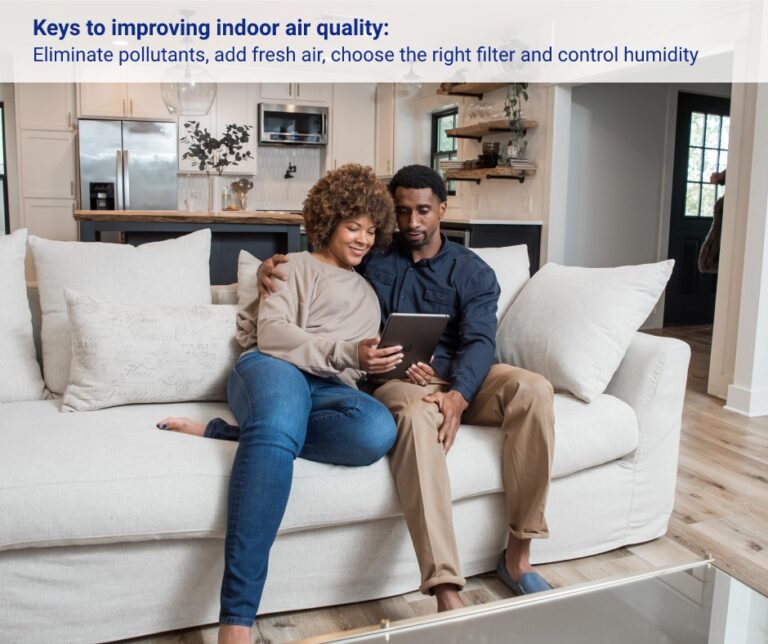
Keys to Improving Indoor Air Quality
Eliminate pollutants, add fresh air, choose the right filter and control humidity.
Home serves as our safe haven and refuge away from the world, but how often do we think about the quality of the air inside it? Most likely, not often enough. Yet we should considering the EPA findings that indoor air pollutant levels are two to five times higher than outdoor levels, and we spend 90 percent of our time indoors. Take a moment to sit in your favorite spot in your home and consider how comfortable you are and the environment around you. Ask yourself these questions:- Do you struggle with dust, pet dander and other airborne pollutants?
- Does the air feel too dry or too damp?
- Is the temperature comfortable and does it stay comfortable with little effort?
Take control of air pollutants
Some sources of air pollution come from within our own homes – like pet dander, dust mites and household chemicals. It’s possible to lessen the impact of these at air pollutants with regular cleaning and reducing the amount of clutter in a home. Use a HEPA-quality vacuum cleaner frequently on rugs, carpets, furniture and pet bedding frequently. Place covers on your mattresses, pillows and box springs, and washing your bedding in hot water at least once a week to combat dust mites. The Asthma and Allergy Foundation of America recommends a washing machine water temperature of 130 degrees Fahrenheit or hotter, as well as drying the bedding on a hot cycle to kill dust mites.Bring in fresh air
When the sources of indoor air pollutants can’t be fully eliminated, consider supplying clean, fresh air to the indoor environment while exhausting stale and polluted air back outside. Here are some dos and don’ts for freshening the indoor air: Do- Filter kitchen air by running the kitchen vent fan while cooking
- Continuously filter the air in your home by running your HVAC fan
- Consider adding a ventilator to your HVAC system like the Envirowise ERV that brings in fresh air and puts it through your home’s filter while pushing out the stale air.
- Open a window, especially if you suffer from asthma or allergies. While it may allow for air exchange, it doesn’t filter the air or block the allergens or asthma triggers that could intrude your home.
Increase your HVAC’s filtering power
Adding a higher quality disposable filter or a whole-home air cleaning system to your HVAC also can help remove airborne particles and provide cleaner air to every room. Disposable air filters – When selecting a disposable filter, look for the MERV rating. The higher the rating, the more it will filter out of your air. We suggest using MERV 11 filters that are changed every 30-90 days. Whole home filtration – When you add a whole home air cleaner like Trane CleanEffects, which can remove up to 99.98% of all airborne particles and is up to 100 times more effective than a standard 1-inch filter. Trane CleanEffects is also certified as asthma and allergy friendly by the Asthma and Allergy Foundation of America, and best of all it does not require any costly replacement filters and can be cleaned at home as needed.Balance the humidity in your home
Maintaining a humidity level of between 35 and 60 percent in the home keeps your home both more comfortable and avoid issues that arise when it the air is too damp or too dry. Mold, dust mites, and other air pollutants tend to thrive outside of that range, and our bodies’ natural immune systems can be comprised when the air gets too dry. Air that is too wet can also cause issues for the home such as warping or cracking wood furnishing and floors. It’s possible to monitor your humidity level by using a reliable HVAC thermostat. Decrease humidity- Remove some humidity when showering by turning on the bathroom fan before, after and during a shower
- Run your air conditioning unit. However when temperatures are mild the HVAC may not run enough to remove moisture from the air.
- Consider adding a dehumidifier to your HVAC system.
- In drier climates or during dry seasons, add humidity through a whole-home evaporative or steam humidifier. It ties into the HVAC ductwork system and adds the appropriate amount of moisture to maintain ideal humidity levels throughout the entire home.
The biggest change to come out of Mass Save for 2022 is the $10,000 rebate on heat pumps but not all homeowners who want to install a heat pump system will qualify. With so much doubt around who qualifies and who does not we’ve summarized the rebate process below with some clarification.
First Step - Weatherization
Before the heat pump installation begins, Mass Save will conduct a Free Energy Audit. Weatherization made during the assessment must be complete prior to heat pump installation.
- Mass Save offers financial assistance with the weatherization upgrades if you qualify for their Enhanced Residential Program or their Income Eligible Program.
Second Step - Find a Qualified Mass Save Partner
Next, find a Mass Save Partner on their website to come assess your home and provide an estimate. The heat pump system must be sized to be able to heat and cool your home as the sole source of heating. Click here to see some important questions to consider during the heat pump installation assessment.
- If you would like to install a heat pump system to heat only certain areas of your home, you will not qualify for the $10,000 rebate. Click here to see partial-home heat pump rebates.
Third Step - Supplemental Heating Requirements
Homeowners may include a back-up or a supplemental heat source from NON-FOSSIL FUEL sources such as a wood or pellet stove or electrical baseboard heat.
- This includes back-up heat sources in spaces that are difficult to serve with air source heat pumps like bathrooms or other smaller areas in the home.
Fourth Step - Removal/Disconnection of Old System
Heat pump installation must include either the complete removal or disconnection of the pre-exisiting heating system OR the homeowner must agree not to use the pre-exisiting heating system unless there is an emergency.
- Emergencies include heat pump maintenance down time or if heat pump is not able to heat the home during an extreme weather event.
Finally - Full Occupation of the Home in the Winter
Home where the heat pump is being installed must be occupied full time during the winter heating season.
- For homeowners who have a second home, the $10,000 rebate will not apply for that home.
At Wilson Brothers we do not want our customers feeling confused about the rebate process. We will help you from start to finish to make the process as smooth and easy as possible.
Heat pumps do not generate heat, they move it. They transfer heat energy from the inside air to the outside or vice versa. In cooling mode, heat energy from inside your home is absorbed by the system’s refrigerant and transferred to the outdoor air. In heating mode, the refrigerant cycle is reversed. The system extracts heat from the outdoor air and transfers it inside your home. This process is cleaner and safer for the planet and produces zero emissions.
Cold climate heat pumps do not require supplemental heat since they are designed to scroll up to meet demand when it’s very cold. When deciding on the heat pump design that will work best for your home, there are a few concepts that are important to understand. Comfort is more than just air temperature. A room with a comfortable air temperature could still feel cold due to radiant losses through windows and drafts. Understanding each room in your home and identifying drafts and rooms with many windows will help you to understand the design of your heat pump system. An HVAC Technician will also have to calculate the load of your home to see how much heat is needed. Your home’s load is made up of various components like insulation, window quality and location, home orientation and more factors that affect heat transfer and air flow. Bigger does not always mean better. An oversized system can lead to short cycling which is when the system turns on and off repeatedly. In order to take advantage of lower utility bills, it is important to understand your home’s load to install the correct size system. A mismatched system can lead to higher utility bills during mild conditions and less temperature control.